
Why Choose a Truly Bespoke Kitchen Over a High-Street Alternative?

Every home is different, and the best kitchens reflect that. A truly bespoke kitchen is shaped around the character of the property and the people who use it every day. Built for your room, your routines and your taste, it’s crafted by people who care about every detail, from the largest cabinet to the smallest joint. The result is a kitchen that feels completely at home within the house.
At Peter Alexander Cabinets, we’ve been designing and making kitchens in the Weald of Kent since 2006, and seeing a finished kitchen installed is still one of our favourite parts of the job. Because “bespoke” is now used to describe all kinds of kitchens, it’s worth explaining what the word really means, and why a real made-to-order kitchen can be worth choosing over a high-street alternative.
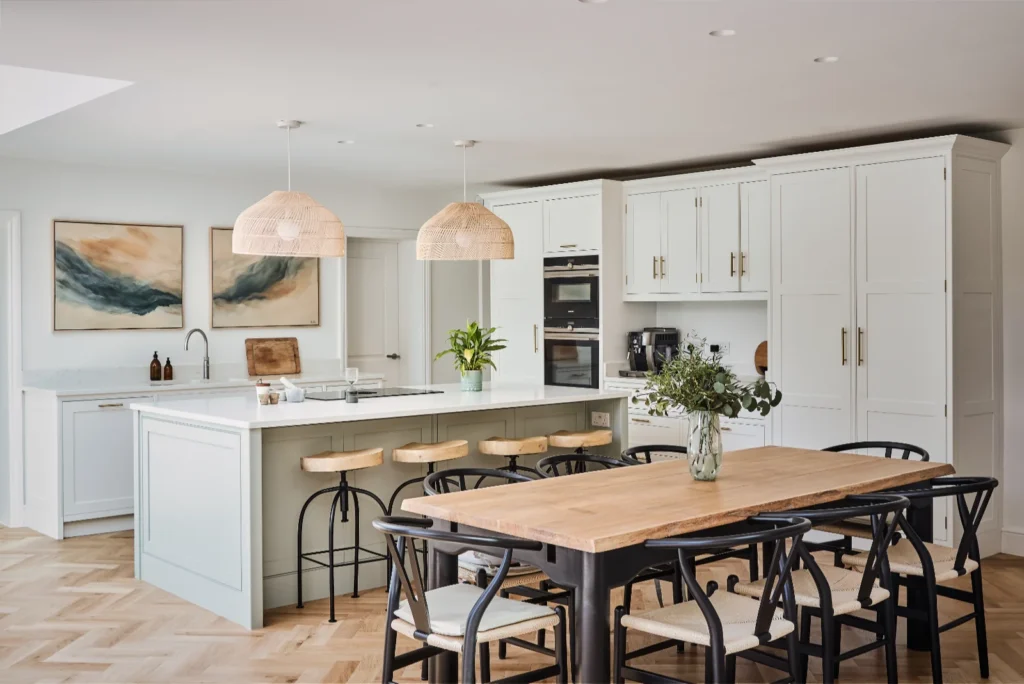
What “bespoke” actually means
“Bespoke” comes from the old verb bespeak, meaning to order or arrange something in advance. It’s best known from tailoring. A bespoke suit isn’t an off-the-peg suit with the sleeves taken up. It’s made from scratch around one person’s measurements.
A bespoke kitchen should work the same way. Every cabinet is made specifically for the space available and the way you use it. Nothing starts life as a stock item.
Many kitchens sold as “bespoke” are something different. They’re usually modular with interchangeable parts. Cabinets come in a fixed range of standard sizes, and any leftover gaps are closed with filler panels. You may choose the door style, handles and colour, which gives a personalised look, but the structure is off the shelf. There’s nothing wrong with that approach, but it isn’t bespoke.
If you’re comparing suppliers, a few questions quickly show the difference:
- Who makes the cabinetry, and can I see where? We welcome clients to our workshop to see their furniture being made. Any maker who is proud of their work should be happy to show you.
- Are cabinets built to any size, or chosen from set widths? Real bespoke work has no standard sizes.
- Who paints it? A hand-painted finish is a large part of how a kitchen looks and wears. Be wary of anyone willing to supply unpainted cabinetry and leave the finish to someone else.
- What happens if something needs attention in five or ten years’ time? We’ll look after any issues for as long as you own your kitchen – more on that below.
The in-frame difference
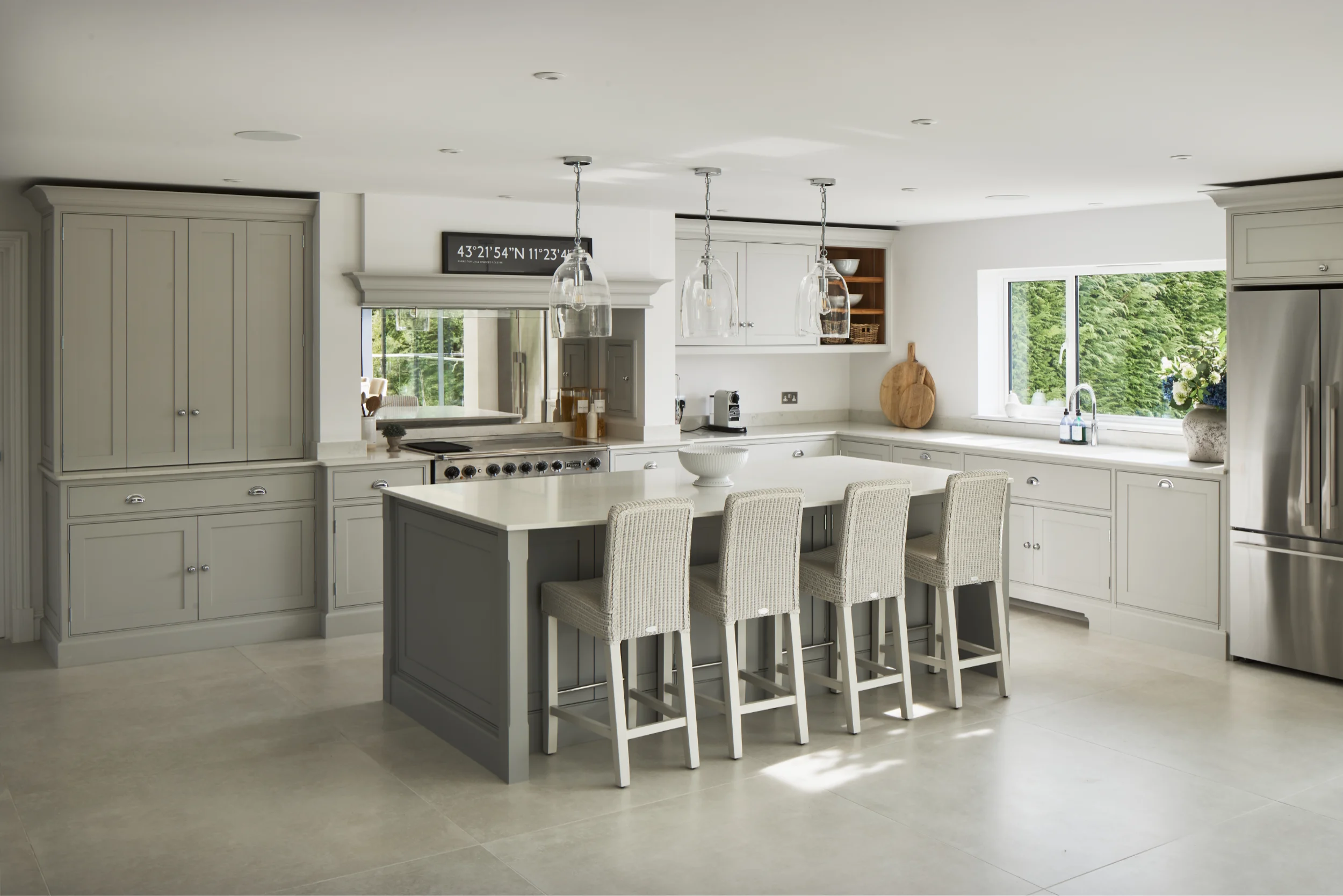
Our kitchens are built in-frame. The doors and drawers sit precisely within a solid wood frame rather than being hung over the front of a box. The margins around every door have to be consistent, so there’s nowhere for imprecise work to hide. That’s why in-frame cabinetry has long been associated with fine furniture making.
We take this a step further. Instead of lining up individual cabinets side by side, we run continuous frames across several cabinets. The result reads as a single piece of furniture rather than a row of units, and it’s one of the clearest visual differences between a truly bespoke kitchen and a mass-produced one.
Design freedom
A high-street kitchen usually starts with a catalogue. You choose from what’s available and arrange it to fit your room as best you can.
A bespoke kitchen starts with the room itself and the people living in it. How do you cook? Who uses the kitchen, and when? Where do you want to sit with a coffee in the morning? What do you want hidden away, and what do you want on display?
That difference shows up in the details. For example, drawers can be fitted out for your own pans and an island can be proportioned to the room rather than to a standard unit. Cabinet styles, mouldings, hardware and colours can be chosen to suit your home, whether it’s a period property or a new build.
It also lets the kitchen connect with the rest of the house. The same craftsmanship can extend to a utility room, boot room, media wall, study or dressing room, creating a continuity that’s hard to achieve when each room comes from a different catalogue.
Better use of space
Standard units are designed for standard rooms, and very few rooms are standard. Older homes especially tend to have walls that aren’t straight, floors that aren’t level, and alcoves, beams or chimney breasts that give the house its character.
When modular cabinets meet an irregular room, compromises follow: filler panels to close gaps, corner units with hard-to-reach space, and dead zones where standard heights stop short of the ceiling.
Bespoke cabinetry is built for the room as it really is. Before anything is made, we carry out a detailed on-site survey so every measurement is precise. Cabinets can then be properly designed to sit against uneven walls, run to the ceiling, or shaped around features that a catalogue kitchen would just cover over. We regularly find useful storage opportunities in places that standard-sized cabinetry would leave unused.
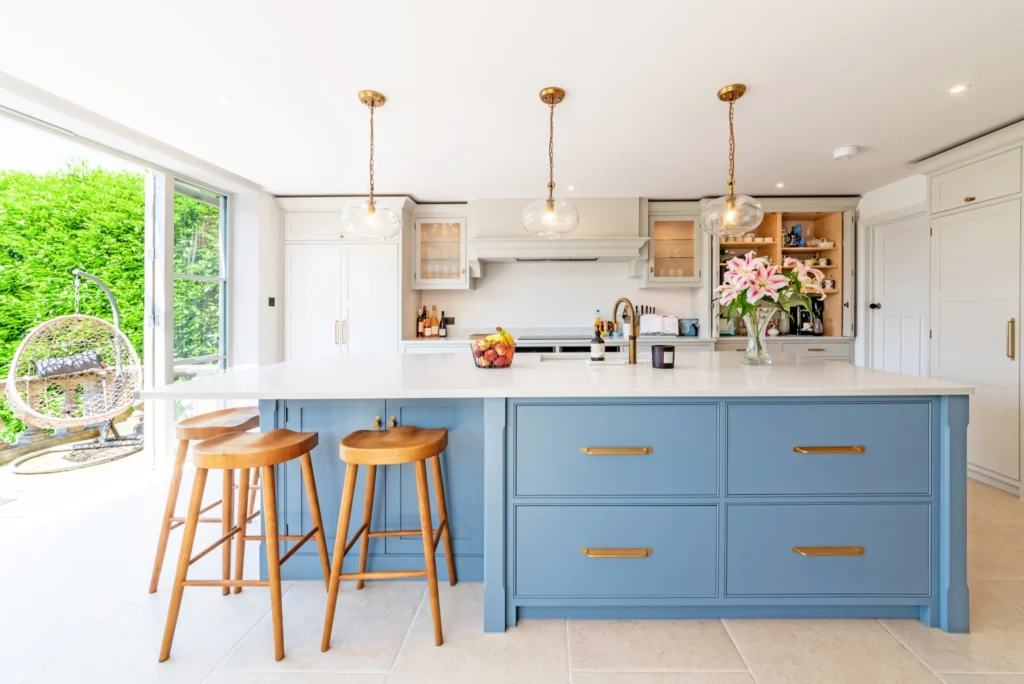
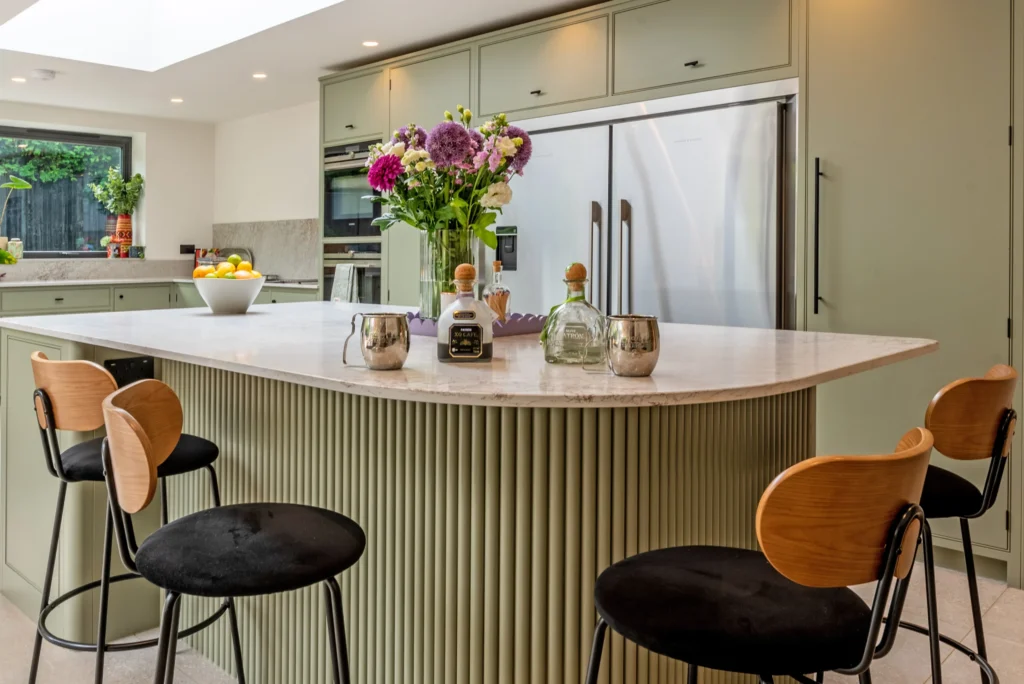

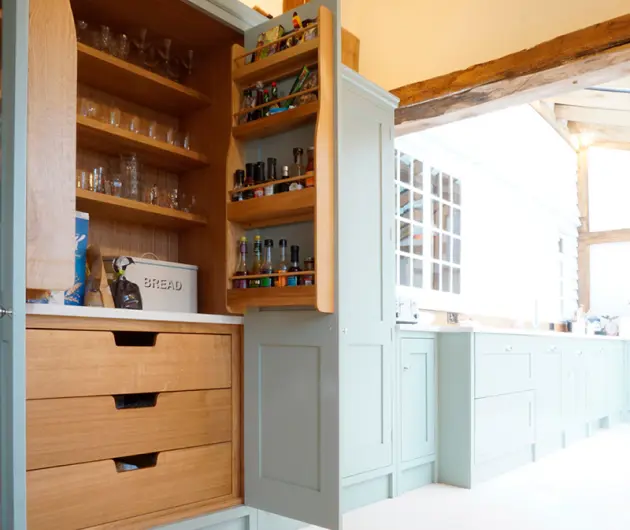
Long-term value and durability
A bespoke kitchen generally costs more upfront than a high-street equivalent, and it’s worth saying so plainly. The real value becomes clearer over time.
- Materials and finish. We use materials chosen for durability, appearance and performance, and we’ve spent years refining the products behind our hand-painted finish so that it’s both beautiful and hard-wearing. A painted in-frame kitchen can also be refreshed or repainted in a new colour in future, without replacing the cabinetry itself.
- Timeless design. A kitchen designed around your home, rather than around this year’s trends, tends to age well.
- Ongoing care. As a small company, we rely on our reputation. For as long as you are the owner of your kitchen, we’ll look after any issues that come up. That kind of relationship is hard to find when the product line you bought from may be discontinued in a few years.
- Part of the house. A well-made kitchen that suits the property is more likely to be seen by future buyers as a feature of the home than as something to rip out. How much it adds varies too much from home to home to promise a figure, but quality is usually seen as a positive selling feature.
Is bespoke right for you?
A high-street kitchen can be the sensible choice, particularly for a straightforward room, a tight budget or a home you don’t plan to stay in for long.
Bespoke isn’t the right answer for every project, but it tends to make most sense when:
- your room has an unusual shape or features that standard units don’t suit
- you plan to stay in your home for years
- you want a kitchen built around how you actually live
- you value craftsmanship and want to know exactly who made your furniture
If you’d like to discuss a project, get in touch and we’ll see whether a bespoke approach is the right fit for your home. You can read about our process, or visit our FAQs for guidance on typical investment and lead times.